 nojetlag
Jet Lag New York to London (JFK–LHR): Recovery Timeline & Plan
Eastbound protocol · JFK → LHR · 5 time zones · Last updated & sources reviewed: August 2026
On This Page
- Why This Route Feels the Way It Does
- Recovery Timeline
- Before You Fly
- In Flight
- On Arrival
- Know Your Airports: JFK and LHR
- What to Buy
- What You Can't Pack
- Frequently Asked Questions
- Key Takeaways
Flying from New York to London means crossing 5 time zones eastward. Without any adjustment strategy, expect roughly 5 days for full circadian realignment, based on the rule of about one hour of adjustment per time zone crossed. With consistent morning light exposure and disciplined sleep timing, many travelers feel functional within 2–3 days.
A note on seasonal variation: the US and UK change their clocks on different dates, so for a week or two each spring and autumn the gap narrows to 4 hours rather than 5. Flight times also shift: eastbound transatlantic crossings ride the jet stream and typically run somewhere around 6h15m–7h30m, faster than the westbound return. All timings on this page are approximate estimates that vary by season, airline, aircraft and winds — check your specific booking.
This guide covers what's happening to your body clock on this route, and a practical plan to shorten the adjustment window.
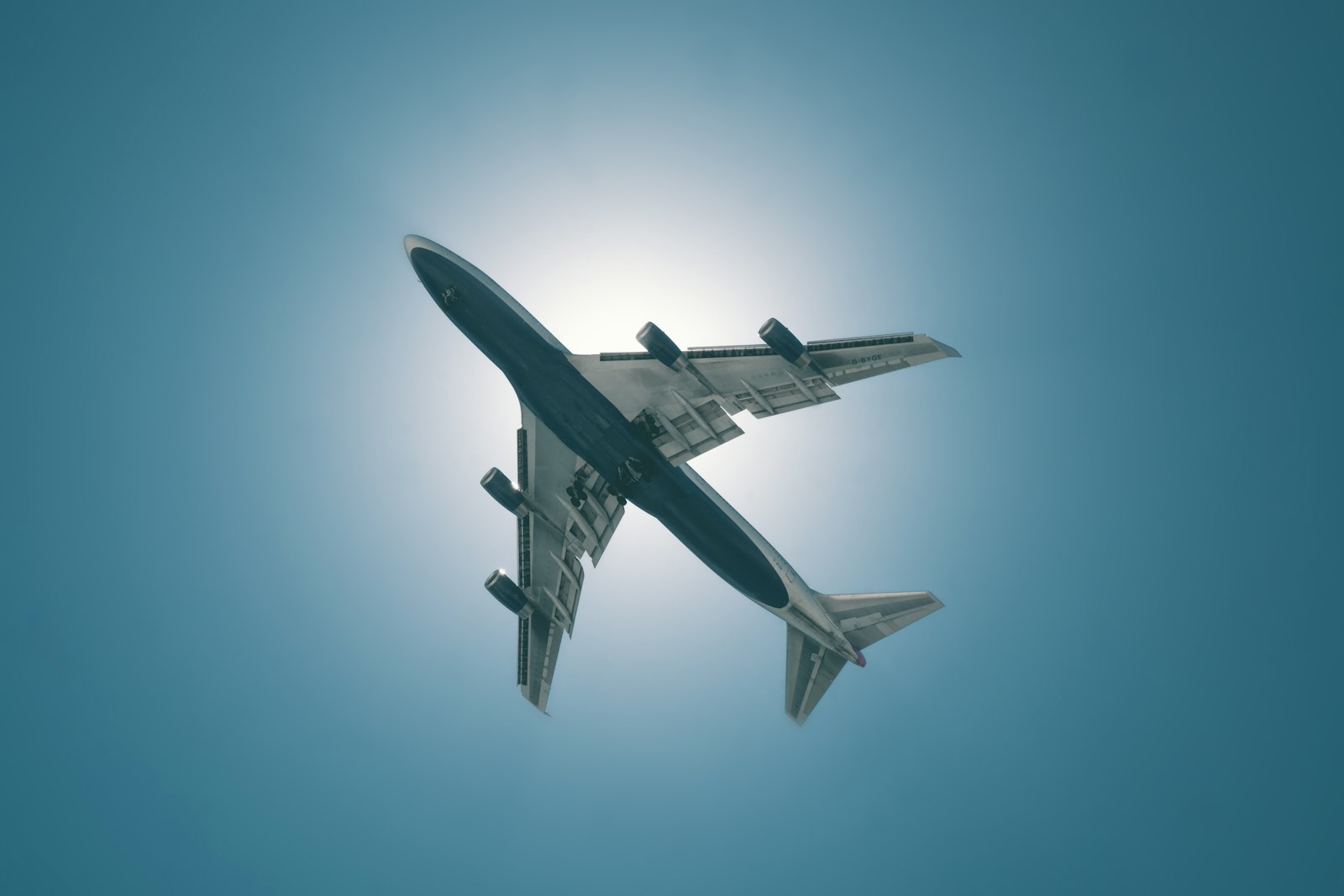
Photo: Spencer Imbrock / Unsplash Operational planning in this guide follows three primary evidence anchors: recovery speed is usually approximately one circadian hour per day eastward and somewhat faster westward (Waterhouse et al., 2007); light timing effects follow the human phase response curve, so morning and evening exposure can shift the clock in opposite directions (Khalsa et al., 2003); and melatonin evidence is strongest for correctly timed short-term use after eastbound travel (Herxheimer & Petrie, 2002). For practical timing details, see our melatonin guide. If you use melatonin, check timing and interactions with a pharmacist or doctor.
Why This Route Feels the Way It Does
Direction works against you. Most human circadian clocks run slightly longer than 24 hours, which makes it easier to delay sleep than to advance it. Flying east means going to bed and waking earlier than your body wants — pushing against your own biology rather than drifting with it. The same five zones flown westward would resolve noticeably faster.
The overnight timing costs you a night. Most JFK–LHR departures leave in the evening and land in London somewhere around 06:00 to 10:00 local — approximate, and worth checking against your own booking, since schedules shift by season and carrier. You lose most of a normal sleep cycle in transit and arrive at the start of a British working day already sleep-deprived, on top of the circadian mismatch. That combination — not the five zones alone — is what makes day one hard.
The return trip (LHR → JFK) is westbound and recovers faster on a different protocol — the light timing reverses, and the characteristic symptom becomes early waking rather than trouble falling asleep.
Recovery Timeline
| Day | What's happening | What to do |
|---|---|---|
| Day of travel | Evening departure, most of one sleep cycle lost in transit | Switch to London time as soon as you board; sleep the middle stretch of the flight |
| Day 1 in London | Peak fatigue, strong pull toward an afternoon nap | Outdoor morning light on arrival; nap no longer than 20–30 minutes |
| Days 2–3 | Sleep quality improving, energy still uneven through the afternoon | Hold the local meal and light schedule even when it feels forced |
| Days 4–5 | Near-full alignment for most travelers | Routine should feel normal; light timing matters much less |
Individual recovery varies with age and chronotype. Morning types tend to adjust to eastward travel faster than evening types.
Before You Fly
Start 3–4 days out, in proportion to a 5-hour shift:
- Move sleep 30–60 minutes earlier each night. Getting even two hours ahead before departure meaningfully shortens what's left to do on arrival.
- Seek morning light at home. Light early in your day nudges the clock in the direction you need.
- Don't arrive with sleep debt. An overnight flight is a poor place to start already short on sleep.
In Flight
- Set your phone to London time at the gate, and make sleep and meal decisions against that clock rather than New York's.
- Sleep the middle portion of the flight. On a typical evening departure, the stretch corresponding to London's small hours is the one worth protecting — that usually means skipping the second meal service.
- Skip alcohol. It fragments sleep architecture and worsens cabin dehydration.
- Hydrate and move. Roughly six to seven hours in the air is long enough for cabin dryness and immobility to compound how you feel on landing.
On Arrival
- Get outdoor morning light as soon as you can. This is the strongest lever available for advancing your clock — more effective than caffeine, melatonin, or determination.
- Resist the long nap. Twenty to thirty minutes in the early afternoon is recoverable; two hours is not.
- Eat at local times even without appetite. Meal timing is a secondary cue for your peripheral clocks.
- Walk outdoors. Light exposure and gentle movement in one.
- Cap caffeine to the morning, avoiding it within roughly six hours of your target London bedtime.
Know Your Airports: JFK and LHR
Departing from John F. Kennedy International Airport (JFK)
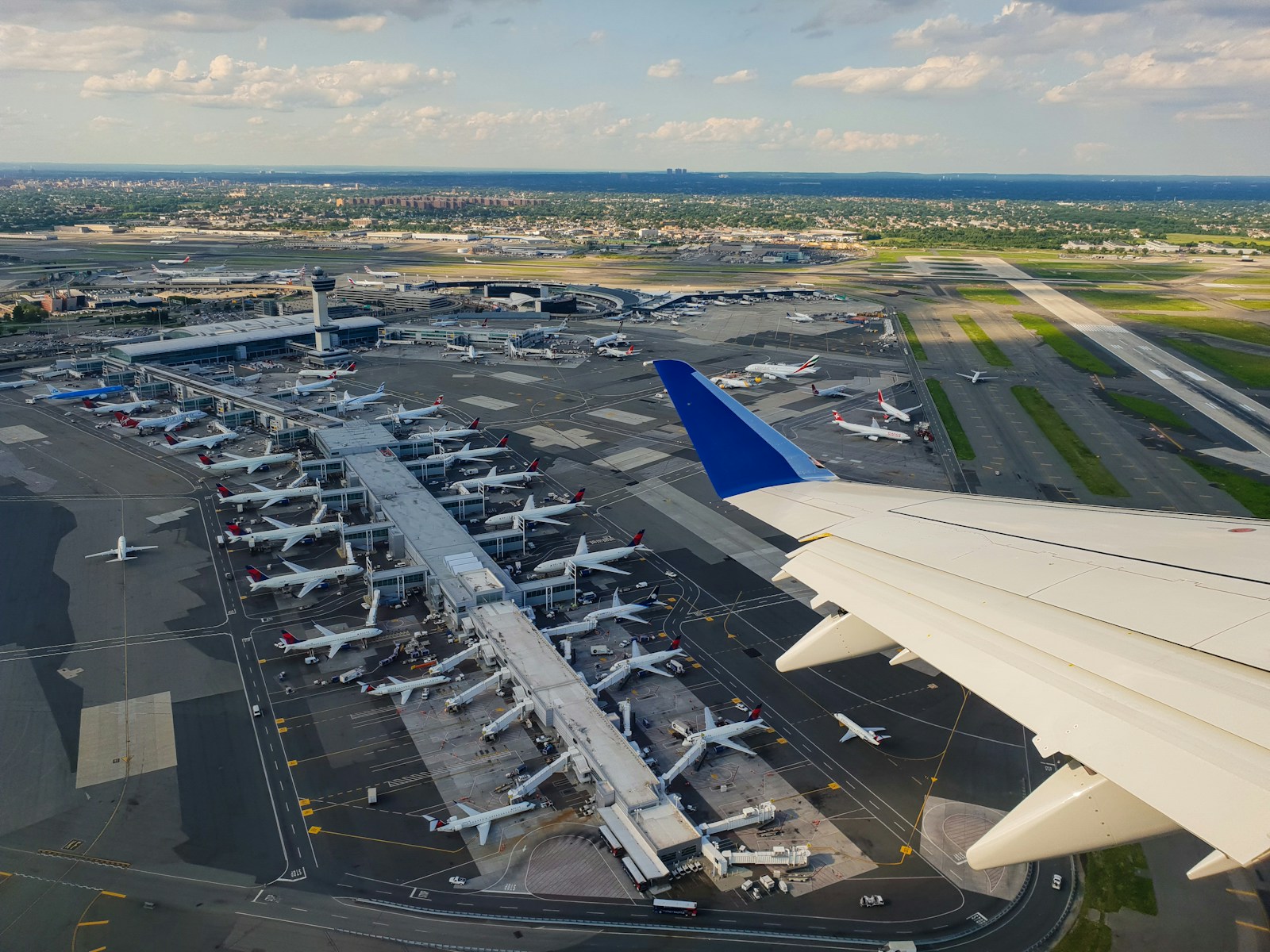
JFK spreads across eight terminals with no airside connector between them, so your terminal depends on your airline, not your destination. Confirm it on your boarding pass or airline app within 24 hours of departure — assignments keep shifting as the airport's multi-billion-dollar redevelopment continues through 2026. Terminals 4 and 8 host most international carriers on this route.
- Give yourself the full three-hour international buffer. Each terminal runs its own checkpoint, and wait times are posted on the airport's homepage.
- AirTrain between terminals is free — useful if you're connecting from a domestic arrival.
- Add 20–30 minutes to ground transport during peak hours: construction around the Van Wyck Expressway and the New Terminal One project regularly slows the approach. Worth building in, since arriving stressed is a poor start to a flight where the goal is winding down.
Arriving at Heathrow Airport (LHR)
Heathrow's terminals close to non-passengers roughly between midnight and 04:00, and no flights are scheduled between 22:55 and 04:40. If you land at 06:30 feeling wrecked, the temptation is to find a quiet corner — but pushing through to daylight is the better move for a five-zone eastward shift.
- If you genuinely need to reset before continuing: YOTELAIR in Terminal 4 offers compact cabins bookable in four-hour blocks with en-suite showers. Aerotel in Terminal 3 is a similar setup a short walk from arrivals.
- Shower without booking a cabin: Plaza Premium Lounges in Terminals 2 and 4 sell shower-only access — often enough to feel human before heading into the city.
- Heathrow Express runs from a station between Terminals 2 and 3; Terminals 4 and 5 have their own stations. Budget a few extra minutes if you're arriving into T4 or T5.
A Few Fun Facts to Pass the Time in Line
At JFK:
- There's a hidden softball field near Cargo Area A, used by airport staff and closed to the public.
- The Bay Runway (31L) is the second-longest in the United States and was once designated a backup landing site for NASA's Space Shuttle.
- A dedicated animal terminal nicknamed "The ARK" handles horses, dogs, cats and birds moving as cargo, complete with wellness facilities.
- Eero Saarinen's 1962 TWA Flight Center survives as the TWA Hotel — you can drink inside a restored 1958 Lockheed Constellation parked outside it.
At LHR:
- Heathrow began in 1930 as a single grass runway.
- There is no Terminal 1 — it closed in 2015 after 47 years, absorbed into Terminal 2.
- A fully built but never-used "ghost" railway platform sits beneath Terminal 5, constructed for a rail link that was never completed.
- New York is consistently Heathrow's single most popular destination, so somewhere in the terminal right now, someone is preparing for exactly the jet lag you're about to have.
What to Buy
For the flight itself
A crossing of roughly seven hours is long enough for the basics to matter: compression socks, a proper eye mask and earplugs rather than the airline-issued ones, and an empty refillable bottle to fill after security. If melatonin is part of your routine, timing matters more than dose, and eastbound overnight timing is specific enough to be worth reading up on separately.
For your first day in London
A charged power bank (your phone will be low on landing and you'll want maps and transit apps), sunglasses for managing glare on a light-sensitive first day, and a contactless card or Oyster set up in advance — one less decision while jet-lagged in an unfamiliar station.
Souvenirs worth the suitcase space
From New York, before you fly:
- A bagel from a proper Manhattan or Brooklyn bakery — it won't survive the week, but it makes a good pre-flight breakfast ritual.
- Something from the MTA's official store using the real subway map design: prints, mugs, apparel.
- Yankees or Mets gear, easy to grab in the terminal if you left gift-buying late.
From London, before you fly home:
- Tea is the one genuinely worth the space. Fortnum & Mason and Whittard both have Heathrow concessions for last-minute airside buying.
- A Paddington Bear item — specific to London in a way that's hard to fake elsewhere.
- Shortbread, or British-formulation Cadbury, which differs from the US version enough that returning travelers notice.
What You Can't Pack
These come from national regulators, not your airline — they apply whichever carrier you fly, but differ by departure country.
Flying out of JFK (TSA rules)
- Liquids over 3.4 oz (100ml) must go in checked baggage. The US has not adopted the larger-container CT scanner exception now in use at some UK airports.
- Spare lithium batteries and power banks go in carry-on only, never checked. Power banks over 27,000mAh (100Wh) are banned from both.
- Butane-powered curling irons or flat irons, and spare gas cartridges for them, are banned from checked baggage.
- Foldable utility knives and multi-tools are banned from carry-on regardless of blade length.
- Realistic replica weapons — toy guns, grenade-shaped novelties, knife-shaped belt buckles — are banned from carry-on.
- Self-heating meal kits (MREs) are banned from both carry-on and checked.
- Alcohol above 140 proof is banned entirely.
Flying out of LHR — for your return or any connection (UK rules)
- Heathrow has scrapped the 100ml limit. Following its CT scanner rollout, containers up to 2 litres are permitted in hand luggage and you no longer need to remove liquids or electronics from your bag. This affects your return leg only — it has no bearing on arriving into the UK.
- The allowance doesn't travel with you. A 500ml bottle cleared at Heathrow can be refused at a connecting airport still running the older rule. If you're transferring, pack to the stricter standard.
- Two-bag limit at the security checkpoint — a cabin bag plus one personal item. Anything beyond that must be checked.
- One lighter per person, carried on your person rather than in a bag.
Confirm current rules on the TSA and gov.uk sites before departure — screening technology is being updated faster than most travel guides.
Frequently Asked Questions
How long does jet lag from New York to London actually last? Around 5 days for full circadian realignment, following the rule of roughly one day per time zone crossed eastward. With consistent morning light exposure and a structured sleep schedule, many travelers feel functional within 2–3 days, though "functional" and "fully adjusted" aren't the same thing.
Is it better to sleep on the flight or stay awake? Sleep, on a typical evening departure. The middle stretch of the flight lines up with London's night, so sleeping then starts the adjustment in transit. Staying awake the whole way tends to leave you more sleep-deprived without speeding up the circadian shift.
Does melatonin help on this specific route? It's among the better-evidenced interventions for eastward jet lag, but timing and dosage matter more than most people assume — it isn't simply "take it and it works." Dosage and timing are worth discussing with a pharmacist or doctor rather than guessing.
Should I arrive a few days early for an important event? For anything needing peak mental performance — a conference talk, a negotiation — arriving 2–3 days ahead gives your clock meaningful time to move before you have to perform.
Key Takeaways
- JFK–LHR crosses 5 time zones eastward, the harder direction for circadian adjustment.
- Baseline recovery is about 5 days, compressible to 2–3 with consistent morning light and disciplined sleep timing.
- Morning light on arrival is the single most powerful tool available.
- The return leg is westbound, recovers faster, and needs a different protocol.
This article reflects general circadian rhythm research and is not medical advice. Individual recovery time varies. This page contains affiliate links; we may earn a commission at no extra cost to you.
Sources
- Waterhouse J., Reilly T., Atkinson G., Edwards B. (2007). Jet lag: trends and coping strategies. The Lancet. https://pubmed.ncbi.nlm.nih.gov/17398311/
- Khalsa S.B.S., Jewett M.E., Cajochen C., Czeisler C.A. (2003). A phase response curve to single bright light pulses in human subjects. Journal of Physiology. https://doi.org/10.1113/jphysiol.2003.040477
- Herxheimer A., Petrie K.J. (2002). Melatonin for the prevention and treatment of jet lag. Cochrane Database of Systematic Reviews. https://doi.org/10.1002/14651858.CD001520
 Sony ULT WEAR Noise Canceling Wireless Headphones
Blocks engine noise for in-flight rest.
See product Joint Genius Travel Neck Pillow Premium Memory Foam
Stops head drop for real in-flight sleep.
See product URJD Universal Travel Adapter 100W GaN
Charge all devices in 200+ countries.
See product Contoured blackout sleep mask
Protects your sleep window from stray light.
See product Graduated compression socks
Supports circulation on long flights.
See product Vanicream Daily Facial Moisturizer with Ceramides & Hyaluronic Acid
Rehydrates skin after dry cabin air.
See product Epielle Makeup Remover Wipes
Freshen face on arrival without a sink.
See product GuruNanda Disposable Travel Toothbrush 2.0 (21 ct)
Brush & floss on the go, no water needed.
See product